Cisco® Unified Communications is a comprehensive IP communications system of voice, video, data, and mobility products and applications. It enables more effective, more secure, more personal communications that directly affect both sales and profitability. It brings people together by enabling a new way of communicating-where your business moves with you, security is everywhere, and information is always available...whenever and wherever it is needed. Cisco Unified Communications is part of an integrated solution that includes network infrastructure, security, mobility, network management products, lifecycle services, flexible deployment and outsourced management options, end-user and partner financing packages, and third-party communications applications.
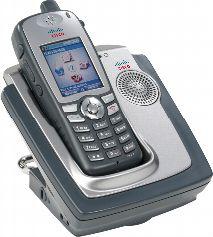
The power of the Cisco Unified Communications family of products extends throughout the enterprise by delivering a powerful, converged wireless solution with intelligent wireless infrastructure and an innovative product with the new Cisco Unified Wireless IP Phone 7921G (Figure 1).
Figure 1. Cisco Unified Wireless IP Phone 7921G
Features
The Cisco Unified Wireless IP Phone 7921G supports a host of calling features and voice-quality enhancements. Because the Cisco Unified Wireless IP Phone 7921G is designed to grow with system capabilities, features will keep pace with new system enhancements. Table 1 provides a list of the features, Table 2 summarizes wireless characteristics, Table 3 lists specifications, Table 4 lists accessories, and Table 5 provides certification and compliance information.
Table 1. Features
| Features | Description |
| Features | • Six line appearances • Abbreviated dialing • Adjustable ringing and volume levels • Adjustable display brightness and timeout • Any-key answer • Audible and vibrating ringers • Auto answer • Autodetection of headset and autoanswer from headset • Automatic keypad lock • Barge • Call back • Call forward • Call history lists • Call park • Call pickup • Call timer • Call waiting • Caller ID • cBarge • Corporate directory • Conference • Direct transfer • Extension mobility service • Fast dial service • Group call pickup • Hold • Hotkey for keypad lock, vibration and ring toggle, and voicemail access • Immediate divert • Join • Last number redial • Malicious caller ID • Message waiting indicator • Meet-me conference • Multilevel precedence and preemption (MLPP) • Music on hold • Mute • Network profiles (automatic) • On- and off-network distinctive ringing • OPickUp • Personal directory • Predialing before sending • Privacy • Quality report tool (QRT) • Redial • Ring tone per line appearance • Service URL • Shared line • Time and date display • Transfer |
| Buttons | • Two soft key buttons to access screen-based applications, features, and functions • Application button that can support Push-to-talk via XML • Mute • Speakerphone • Five-way navigation support • Volume control • Send button and Power/End button |
| Display | 2 in. (5 cm) color display with 176 x 220 pixel resolution |
Table 2. Wireless Characteristics
| Item | Description |
| LED | Ring, message waiting, and charging LED |
| Protocol support | • Skinny Client Control Protocol (SCCP) • Cisco Unified Communications Manager Versions 4.1, 4.2, 4.3, 5.0, and later • Cisco Unified Communications Manager Express Version 4.1 and later • Cisco Unified Survivable Remote Site Telephony (SRST) Version 4.1 and later • Cisco Compatible Extensions Version 4.0 • Extensible markup language (XML) |
| Codec support | G.711a, G.711u, G.729a, and G.729ab audio compression codecs |
| Configuration options | • Dynamic Host Configuration Protocol (DHCP) client or statically configured • Support for online firmware upgrades using Trivial File Transfer Protocol (TFTP) • Domain Name System (DNS) |
| Network features | • Cisco Discovery Protocol • Transparent secure roaming • Provisioning of network parameters through DHCP |
| Security features | • Certificates • Image authentication • Device authentication • File authentication • Signaling authentication • Secure Cisco Unified SRST • Media encryption using Secure Real-Time Protocol (SRTP) • Signaling encryption using Transport Layer Security (TLS) Protocol • Certificate authority proxy function (CAPF) • Secure profiles • Encrypted configuration files |
| Provisioning and management | • Web server for configuration and statistics • Capability to disable local phone settings • Quality-of-service (QoS) reporting: jitter, delay, dropped packets, and latency on a per-call basis • Real Time Control Protocol (RTCP) support and monitoring • Syslog |
| Deployment tools | Integrated site survey tool |
| Language support | Catalan, Danish, Dutch, English, Finnish, French, German, Italian, Japanese, Norwegian, Portuguese, Spanish, and Swedish |
| Network standard | IEEE 802.11a, 802.11b, and 802.11g |
| Frequency band and operating channels | • FCC: (-A) • 2.412-2.462 GHz; 11 channels • 5.15-5.25 GHz Unlicensed National Information Infrastructure (UNII-1), 5.25-5.35 GHz (UNII-2), and 5.725-5.825 GHz (UNII-3); 12 channels • 5. 47-5.725 GHz; 11 channels • ETSI: (-E) • 2.412-2.472 GHz; 13 channels • 5.15-5.725 GHz; 19 channels • Japan : (-P) • 2.412-2.472 GHz; 13 channels Orthogonal Frequency Division Multiplexing (OFDM) • 2.412-2.484 GHz; 14 channels Complementary Code Keying (CCK) • 5.15-5.725 GHz; 19 channels • Rest of World: (-W) • Uses 802.11d to identify band ranges and channels |
| Support mode | • 802.11a • 802.11b/g • Autosensing, 802.11b/g preferred over 802.11a • Autosensing, 802.11a preferred over 802.11b/g • Received signal strength indicator (RSSI) (default) |
| Data rates | • 802.11a: • 6, 9, 12, 18, 24, 36, 48, and 54 Mbps | • 802.11b: • 1, 2, 5.5, and 11 Mbps | • 802.11g: • 6, 9, 12, 18, 24, 36, 48, and 54 Mbps |
| Nonoverlapping channels | • 802.11a: Up to 23 (including radar channels) • 802.11b/g: 3 (Japan uses 4) |
| Wireless modulation | • 802.11a: OFDM • 802.11b: Direct sequence spread spectrum (DSSS) • 802.11g: OFDM and DSSS |
| Receiver sensitivity (typical) | • 802.11a: • 6 Mbps: -89 dBm • 9 Mbps: -88 dBm • 12 Mbps: -86 dBm • 18 Mbps: -85 dBm • 24 Mbps: -82 dBm • 36 Mbps: -80 dBm • 48 Mbps: -76 dBm • 54 Mbps: -74 dBm | • 802.11b: • 1 Mbps: -95 dBm • 2 Mbps: -89 dBm • 5.5 Mbps: -89 dBm • 11 Mbps: -85 dBm | • 802.11g: • 6 Mbps: -90 dBm • 9 Mbps: -89 dBm • 12 Mbps: -87 dBm • 18 Mbps: -85 dBm • 24 Mbps: -82 dBm • 36 Mbps: -78 dBm • 48 Mbps: -74 dBm • 54 Mbps: -73 dBm |
| Transmitter output power | • 802.11a OFDM: • 40 mW (16 dBm) • 32 mW (15 dBm) • 20 mW (13 dBm) • 8 mW (9 dBm) • 3.2 mW (5 dBm) • 1 mW (0 dBm) | • 802.11b CCK: • 50 mW (17 dBm) • 20 mW (13 dBm) • 8 mW (9 dBm) • 3.2 mW (5 dBm) • 1 mW (0 dBm) | • 802.11g OFDM: • 40 mW (16 dBm) • 32 mW (15 dBm) • 20 mW (13 dBm) • 8 mW (9 dBm) • 3.2 mW (5 dBm) • 1 mW (0 dBm) |
| Range (stated ranges are from measured open-site range testing) | • 802.11a: • 6 Mbps: 610 ft (186 m) • 9 Mbps: 610 ft (186 m) • 12 Mbps: 558 ft (170 m) • 18 Mbps: 541 ft (165 m) • 24 Mbps: 508 ft (155 m) • 36 Mbps: 426 ft (130 m) • 48 Mbps: 328 ft (100 m) • 54 Mbps: 295 ft (90 m) | • 802.11b: • 1 Mbps: 1,027 ft (313 m) <
| Informacje ogólne |
| Model: |
IP 7921G
|
| Kod producenta: |
CP-7921G-E-K9=
|
| Typ: |
Telefon VoIP
|
Drukuj opis
Dokładamy wszelkich starań aby podane zdjęcie i opis były w pełni prawidłowe i kompletne. Niestety, nie możemy zagwarantować, że podane dane nie zawierają pomyłek i błędów które jednak nie mogą być podstawą do ewentualnych roszczeń. W razie jakichkolwiek wątpliwości lub chęci uzyskania dodatkowych informacji prosimy o kontakt z działem handlowym. Prezentowany katalog produktów nie stanowi oferty handlowej w rozumieniu Kodeksu Cywilnego, a ma jedynie charakter informacyjny.
Jeżeli zanalazłeś błąd w powyższym opisie, zawiadom nas o tym.
do góry
Gwarancja
| Długość gwarancji: | 12 mies. |
| Typ gwarancji: | Producenta |
Podzieliliśmy dział opinii naszych Klientów na dwie grupy. W zakładce 'recenzje' prosimy o podzielenie się swoimi wrażeniami z korzystania z produktu. Problemy i możliwości ich rozwiązania, pytania i odpowiedzi techniczne prosimy publikować w zakładce 'zapytania techniczne'.
Recenzje jak i zapytania techniczne oraz komentarze do nich tworzone są przez Klientów - społeczność naszego sklepu, nie przez pracowników Morele.net. Jeżeli chcesz zadać pytanie o produkt pracownikowi naszego sklepu skorzystaj z przycisku 'zapytaj o produkt', który znajduje się pod obrazkiem produktu.
Zapraszamy do dyskusji!
Zapytania techniczne produktu
Brak zapytań w bazie.
do góry
|